

Quick answer: Offering handyman services means an hourly or half day rate covering labour, ordinary fixings like screws, wall plugs, filler and sealant, and leaving the room as we found it. It does not automatically cover specific parts, rubbish removal or access equipment. The honest version of the job also includes a walk-round before anything starts, an order of work that respects drying times and neighbours, and a firm line at gas and notifiable electrical work.

The gap people notice is between the advertised rate and the final invoice. Almost always it comes down to three things nobody discussed at booking: a part that had to be fetched, rubbish that had to go somewhere, and half an hour lost to a van with nowhere legal to sit.
None of that is a scam. All of it is avoidable with one conversation at the start.
What’s included when we’re offering handyman services?
Labour and time are the obvious part. The less obvious part is consumables. We carry screws, plugs, mirror plates, filler, caulk, sealant, sandpaper and a reasonable range of brackets, and none of that gets itemised on a bill. Dust sheets, floor protection and clearing up afterwards sit in the same bracket.
What falls outside is anything specific to your property. A particular blind bracket, a matching tap cartridge, a replacement sash cord, a paint colour that has to be mixed. If you tell us the makes and models when booking, we bring them. If you do not, someone spends chargeable time in a merchant on Golborne Road.
Access equipment is the other exclusion worth naming. Standard steps come as part of the handyman services we run in Notting Hill. A tower or a proper long ladder for a three storey stairwell does not, because hiring it is a real cost that has to sit somewhere.
Where rubbish removal becomes a legal question
This one surprises people. Anyone transporting waste as part of their business in England must register with the Environment Agency as a waste carrier, and the duty of care runs both ways. If you hand your old wardrobe to someone unregistered and it ends up dumped on a side street in Wormwood Scrubs, the liability can follow back to you.
Checking takes a minute on the Environment Agency’s public register of waste carriers. Ask for the registration number, not a verbal assurance. Any legitimate operator will give it without hesitating, because they had to pay for it.
The practical effect on a booking is simple. Small offcuts and packaging go with us as part of the job. A flat’s worth of old furniture is a separate arrangement with its own price. I covered the same principle from a different angle in the piece on home maintenance visits, where the rubbish from a full list adds up faster than anyone expects.
Outdoor handyman services, ladders and the hours we can work
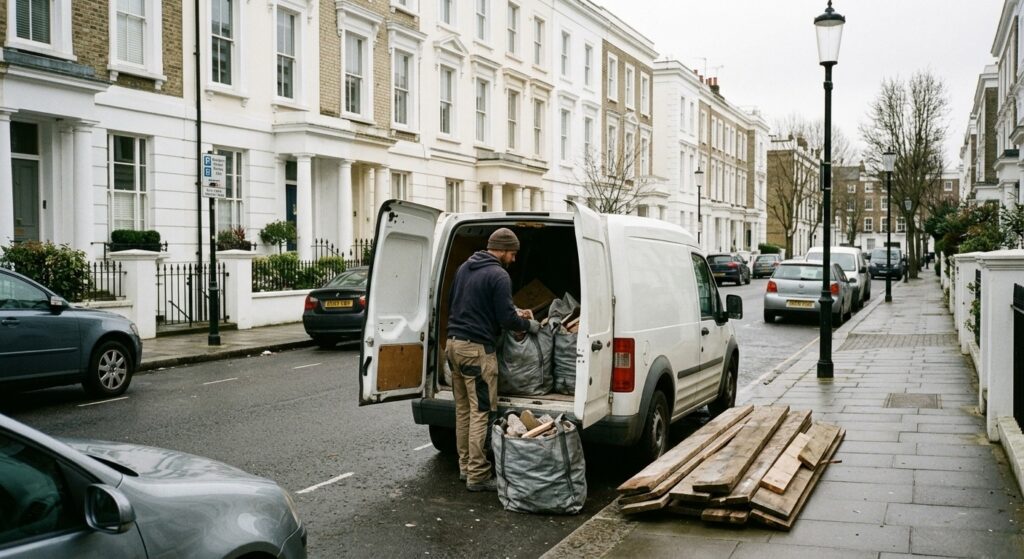
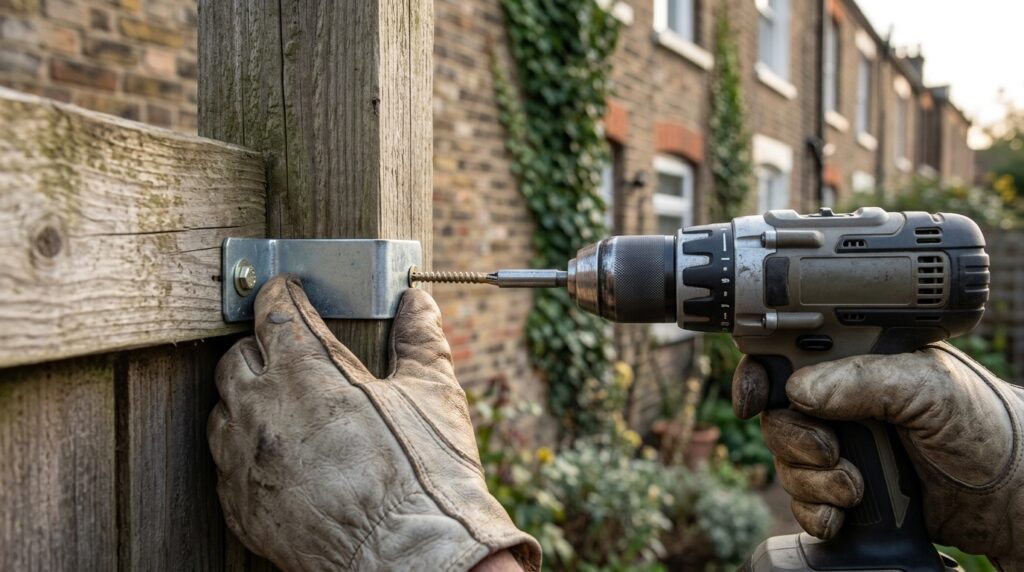
Outdoor handyman services cover gutters, fence panels, gates, external sealant, garden taps, shed repairs and rear elevation touch ups. They stop at the roof. Anything requiring someone to be on tiles or a parapet is a roofer’s job with a roofer’s equipment, and I would rather say so on the phone than halfway up.
Timing outdoors is a local matter. The Royal Borough sets permitted hours for noisy works audible at the site boundary at 8am to 6pm Monday to Friday, with none permitted on Saturdays, Sundays or bank holidays. Those hours are written for construction sites rather than a two hour handyman visit, though in a Ladbroke Grove terrace with a shared party wall they are the benchmark neighbours and porters go by. We work to them by default.
Communal gardens add another layer. In many Notting Hill garden squares the shared side is managed by a committee with its own rules on access, storage and working hours, and a polite email beforehand prevents an awkward conversation over a fence panel.
Booking online, and what a form cannot see
An online handyman service booking works well for defined jobs. Flat-pack of a known model, a TV bracket where you know the wall type, a tap washer. It works badly when the form has no way of asking the question that actually determines the time.
Photographs help more than descriptions. A picture of the wall, the item, and the route to the room answers most of what we need. Tell us the floor, whether there is a lift, and whether the stairwell has a half landing that turns, because a wide item and a Victorian half landing are a well known argument.
Some jobs look like handyman work online and are not. Stripping out display walls, plinths, brackets and framed pieces after a pop-up or a show is closer to the fit-out side of moving an exhibition than to an afternoon of odd jobs, and pricing it as the latter helps nobody.
What the law includes in every job, written down or not?
Every job we take for a domestic customer carries terms nobody has to type out. Under the Consumer Rights Act 2015, a service must be performed with reasonable care and skill. Where no price was agreed in advance, the price must be reasonable. Where the work falls short, you have a right to repeat performance at no further cost to you.
That last point is the one worth knowing. A firm offering handyman services cannot contract out of it in their terms, and any set of terms claiming otherwise tells you something useful about the business.
It also explains why we quote the way we do. Offering handyman services on a vague hourly rate with no scope shifts every uncertainty onto the customer. Naming what is included, what is extra, and what needs a registered trade puts it back where it belongs. That is how we work at Move-on Up, across Notting Hill, Kensington, Holland Park and the rest of West London.