

Quick answer: Gallery relocation service work is about much more than carrying framed pictures from one building to another. A safe move depends on surveying the route, recording the condition of every item, choosing suitable packing, planning collection and delivery times, and coordinating with the people responsible for the exhibition. In West London, narrow staircases, controlled-access buildings and restricted parking can matter as much as the artwork itself. The right gallery relocation service protects the collection and keeps the exhibition programme on schedule.
What a gallery relocation service should cover
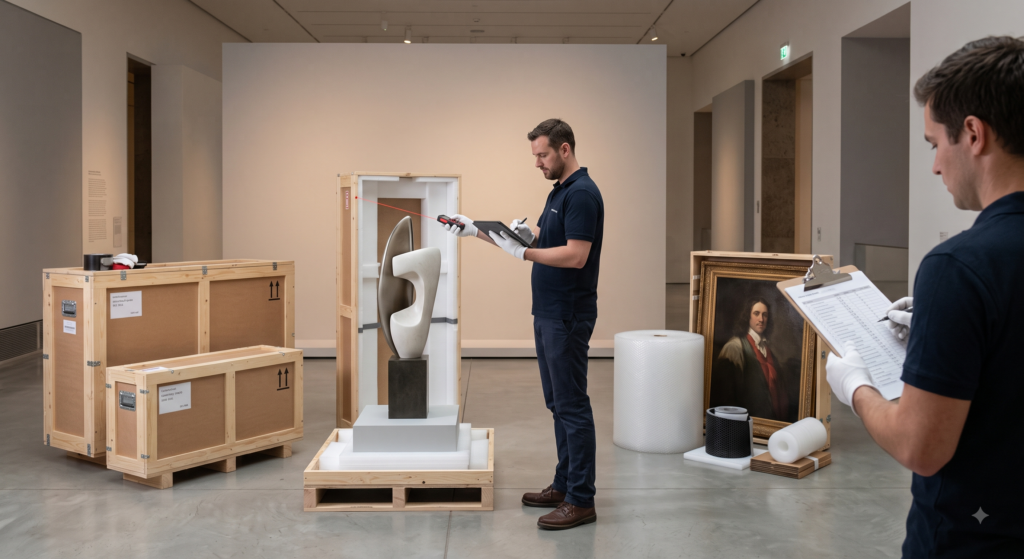
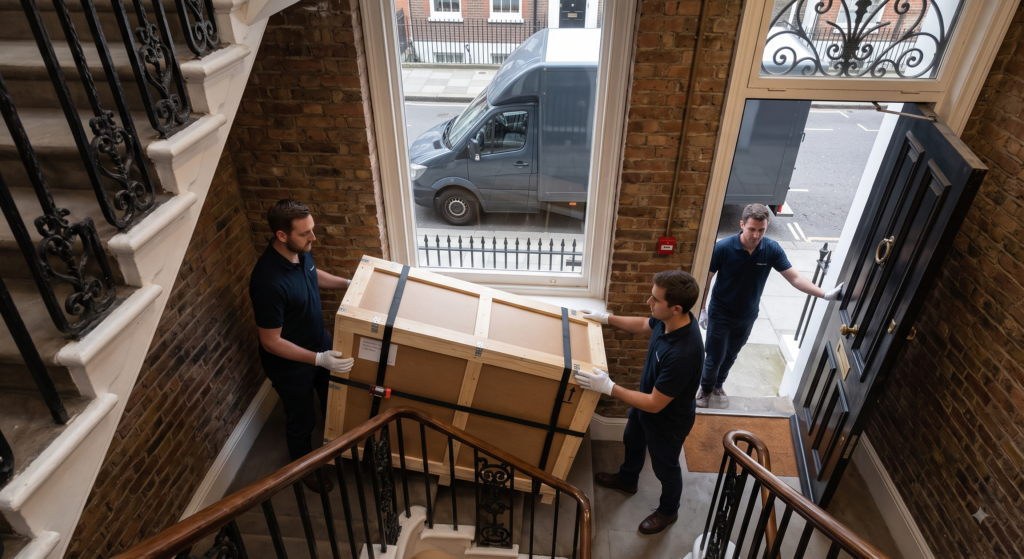
A gallery move usually has several separate stages, even when the collection travels only a short distance. The first is a site survey. We look at door widths, staircases, lifts, loading points, floor surfaces and the route from the van to the display area. A Georgian townhouse in Kensington may have a tight half-landing that rules out carrying a large frame upright. A converted warehouse near Shepherd’s Bush may offer more space, but still require timed access through a shared loading entrance.
The survey also identifies the condition and handling needs of each item. Paintings, sculpture, photography, glazed works and mixed-media pieces should not all be treated in the same way. We note existing marks, loose components, fragile frames and any instructions supplied by the gallery, artist, registrar or conservator.
The collection is then matched to the appropriate vehicle, crew and packing method. Some works can travel in padded picture crates or robust transit frames. Others need bespoke crates, corner protection, suspension, moisture-resistant barriers or additional internal support. A professional art transport service in Kensington can coordinate these decisions before collection day rather than improvising at the loading bay.
Planning exhibition transport in West London
Exhibition transport often fails because the route is treated as an afterthought. A van may be able to reach the street, but that does not mean it can stop outside the gallery at the required time. Notting Hill and Holland Park contain many streets where parking controls, resident permits, one-way systems and limited kerb space affect loading.
We allow time to confirm access arrangements with the venue. That may include a loading bay, a service entrance, a goods lift booking, a building manager’s approval or a temporary parking arrangement. The Royal Borough of Kensington and Chelsea publishes information about parking suspensions and restrictions, so it is sensible to check the council’s current requirements rather than assume that a crew can wait outside legally. The council’s parking suspension guidance is a useful reference when a collection needs dedicated kerb space.
The delivery schedule should allow for the work itself. Unloading a crate, opening it safely, checking the condition report and positioning the item may take longer than the drive across West London. A private view or opening date does not change the time needed to handle an artwork carefully.
Packing works for a gallery move
Packing should prevent movement, abrasion, impact and unsuitable exposure during the journey. A frame should not rub against another frame, and a sculpture should not be held by a delicate projecting part simply because that is the easiest place to grip it.
For framed works, we may use clean wrapping, corner protection, rigid boards and padded separation. Glazing needs particular care because cracked glass can damage the artwork behind it. If a work has ornate corners, a soft buffer should support the solid frame rather than press against the decorative detail. The Australian Institute for the Conservation of Cultural Materials recommends separation battens and foam padding for safe handling and transport, and notes that some wrapping materials should not be used for long-term storage because they can trap moisture. Its handling and transport guidance gives useful detail on these principles.
A travelling exhibition transport project may involve repeated unpacking and repacking at several venues. In that case, the packing needs to be durable, clearly labelled and simple for the authorised team to use consistently. Each crate or package should have an inventory reference, orientation markings and handling instructions where appropriate.
The gallery or artist should supply any existing packing specifications. If a work has a specialist crate, suspension system or conservation requirement, we follow the documented method and raise questions before the collection takes place.
Managing gallery fit-out removal
Gallery fit-out removal is a different job from transporting a collection. It may involve plinths, display walls, lighting equipment, cabinets, graphics, tools and protective materials, alongside artworks that need separate handling. The removal plan should divide those categories so that heavy dismantling work does not put finished or fragile pieces at risk.
We start by identifying what is being retained, recycled, stored or disposed of. Display components may need to be labelled by room or installation sequence. Screws, brackets and small fittings are easy to lose, so they should be bagged and marked against the relevant item. Large panels need a safe route out of the building, particularly where the gallery has a communal stairwell or a narrow pavement entrance.
Manual handling also needs proper planning. The Health and Safety Executive advises employers to avoid hazardous manual handling where possible, assess work that cannot be avoided and reduce the risk as far as reasonably practicable. Its guidance recommends considering the load, the working environment, the distance carried and the use of handling aids such as trolleys. The HSE’s manual handling guidance applies to gallery fit-out work as well as ordinary removals.
A gallery moving company should also protect the building during the removal. Floor protection, padded door edges and careful use of trolleys can prevent avoidable damage. In a listed or period property, the route may need more preparation than the collection itself.
Coordinating art exhibition logistics
Art exhibition logistics work best when one person has a clear record of the move. That record can include the inventory, condition notes, crate numbers, collection addresses, access contacts, delivery windows and installation instructions. It should be updated when an item is collected and checked again at delivery.
Communication matters at handover points. The person releasing the work should know what is leaving, while the receiving venue should have time to inspect the item before installation. If there is visible damage to packaging or an artwork, it should be recorded before the package is moved further.
Private view installation transport often takes place under pressure, with walls being finished and contractors still working. We build the delivery around the venue’s readiness rather than sending fragile work into an unfinished space. That can mean separating the arrival of cases, plinths and artworks, or arranging an evening or weekend slot when the public is not present.
For larger projects, we can provide a fixed, transparent quote after reviewing the collection, access and schedule. Move-on Up is based in Notting Hill and works across West London, including Kensington, Bayswater, Chelsea, Fulham, Hammersmith and Maida Vale. Our service is fully insured with goods-in-transit and public liability cover, and flexible scheduling is available where the venue needs a same-day, evening or weekend move.
A gallery relocation service should leave the registrar, artist or venue manager with fewer problems, not a new list of them. Good preparation makes the route predictable, keeps handling controlled and gives every item a clear chain of responsibility from collection to installation.