

Quick answer: Art transport London jobs need more than a padded blanket and a careful driver. A proper job means rigid crating sized to the piece, climate-controlled transport so paintings and antiques don’t crack or warp in transit, specialist insurance that actually covers fine art at its real value, and a route plan that accounts for Notting Hill’s narrow streets, parking restrictions and listed buildings. Skip any one of those four and you’re gambling with something that usually can’t be replaced.
I’ve been moving people in and out of Notting Hill, Kensington and Holland Park for years, and the calls that make me nervous aren’t the four-bedroom houses with a piano. They’re the one-bedroom flat with a single oil painting worth more than the flat itself, or a client moving three generations of inherited furniture that’s never once been wrapped for transport. Most removal companies will happily quote you for that job. Fewer have actually done it properly, and the difference only shows up after something’s already broken.
This is what I tell clients when they ask how we handle art transport London moves differently from a standard house removal.
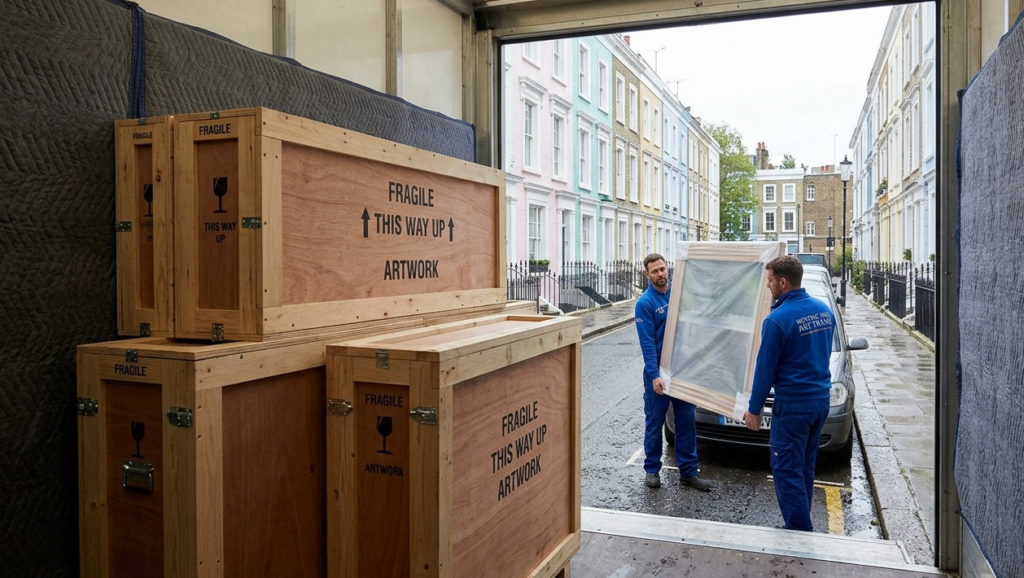
What Makes Art Transport London Different From a Standard House Move
A sofa can survive being dragged down two flights of stairs at an awkward angle. A 19th century gilt frame cannot. The materials, the joints, the surface finishes on fine art and antiques are often decades or centuries old, and they fail in ways that aren’t obvious until you’re already at the new address unwrapping a problem.
The three things I’m watching for on every job involving fragile item removals:
Structural risk
Canvas can slacken or tear, panel paintings can crack along the grain, marquetry can lift if it’s knocked at the wrong angle.
Surface risk
Varnish, gilding and patina scratch or scuff far more easily than people expect, and you often can’t see the damage until the light hits it differently at the new home.
Value risk
Unlike furniture, a damaged piece of art or a chipped antique rarely just gets “fixed.” Restoration is specialist, slow and expensive, and some damage simply can’t be reversed.
How We Crate and Pack Fine Art and Antiques for Art Transport London Jobs
Bubble wrap has its place, but it’s not the plan for anything valuable. For paintings, mirrors and framed work, we build or use rigid crates sized to the piece with internal padding that stops movement in every direction, not just up and down. Corners get reinforced first since that’s where most transit damage actually happens.
For furniture and antiques, the approach changes by material. Upholstered pieces get fully wrapped to keep dust and moisture out. Wood furniture with veneer or marquetry gets corner protection and is never stacked under anything else in the van. Anything with glass, whether it’s a cabinet door or a mirror, travels separately from anything that could press against it. This is the same instinct that drives our wider packing services for fragile and high-value items, just taken further for pieces that can’t be replaced.
The part people don’t see is the loading plan. Art and antiques go in last, get secured so they can’t shift under braking, and come off the van first at the other end. It’s a small detail that prevents most of the damage I’ve seen happen over the years.
Climate Control During Art Transport London Jobs
This is the part most people moving their own art skip entirely, and it’s the one that does slow, invisible damage over time rather than an obvious crack on the day. Paintings, especially anything on canvas or paper, are sensitive to swings in temperature and humidity. Conservation guidance from the American Institute for Conservation puts the safe range for most fine art around 18 to 22°C, with relative humidity held fairly steady and not allowed to swing more than about 5% in a day, since rapid fluctuation is what actually causes warping, cracking or mould, more than the absolute number itself.
That’s the standard museums work to, and it’s the standard we apply when art is involved, particularly in winter when London goes from a cold front step straight into a heated van, or in summer when a piece can sit in direct sun on a pavement for ten minutes while a parking space gets sorted. We keep transit times short and pieces out of direct sun and extreme temperature wherever the move allows for it.
Insurance: What Actually Covers Art Transport London Clients
Most people assume their home contents insurance covers a move. It often doesn’t, and even when it does, the payout for a damaged painting is rarely based on what the piece is actually worth. Standard goods-in-transit cover, the kind most removal firms carry, is built around replacing furniture and boxes, not valuing a piece of art.
Specialist insurance brokers like Marsh and Howden write fine art and specie policies specifically because standard cover falls short here. These policies typically work on an “all risks” basis and are valued against the piece’s actual worth, not a generic per-item limit. If a client has anything of real value moving, I tell them plainly: check whether your own policy actually names fine art, and if it doesn’t, that’s a conversation to have with your insurer or broker before moving day, not after.
Notting Hill’s Listed Buildings Change How We Plan Art Transport London Moves
This is the bit that’s specific to where we work. The Royal Borough of Kensington and Chelsea has 38 conservation areas, covering roughly 70% of the borough, and a large share of Notting Hill’s most beautiful streets fall inside one. That’s not just a planning footnote. It affects how a move actually happens.
Communal hallways in these buildings are often original and protected. Doorways can be narrower than they look. Stairwells in converted Victorian houses frequently have no lift, a tight turn on the half-landing, and a banister nobody wants scuffed. Add a residents’ parking zone and a loading restriction outside, and a straightforward art move becomes a logistics problem before a single crate gets carried.
We plan for this before the day, not on it. That means measuring doorways and stairwells in advance for anything large, checking parking and loading restrictions for the specific street, and building in buffer time so a piece isn’t rushed through a tight space because the clock’s running on a parking bay. It’s the same groundwork we put into every house and flat removal in Notting Hill, just with a lot less margin for error when there’s a painting on board instead of a sofa.
Common Mistakes People Make When Moving Art and Antiques Themselves
The damage I get called about almost always traces back to one of these:
- Wrapping a painting in bubble wrap with no rigid outer protection, so a knock transfers straight through to the canvas
- Stacking furniture or framed pieces flat in a van with no separation
- Leaving art in a hot van or on a sunny pavement for too long
- Assuming home contents insurance covers the piece in transit
- Not measuring the route out of the property in advance, then finding out a sideboard doesn’t clear the stairwell turn
Every one of these is avoidable. None of them are obvious until they’ve already gone wrong.
When to Call a Specialist for Art Transport London
Not every move needs a specialist service. A few framed prints and a bookshelf of antiques can usually travel safely with good general packing. But if you’re moving anything with real financial or sentimental value, anything irreplaceable, anything that’s never been professionally appraised, or anything large enough that it can’t simply be carried by hand around a tight corner, that’s the point to bring in someone who treats it as a specialist job rather than a side note to a general house move.
We run art transport across Kensington and London as a dedicated service, which means the crating, the climate planning and the route survey happen as standard, not as an upsell. If you’ve got a piece you’re nervous about moving, the honest answer is to ask before the van arrives, not after. Get in touch and tell us what you’re moving, and we’ll tell you straight whether it needs the full art transport treatment or whether a standard move will do the job just fine.