

Quick answer: House movers do considerably more than lift boxes. The job is a survey, a volume figure, an access plan, a parking plan, protection for both properties, dismantling and wrapping, a properly restrained load, then the same again in reverse at the other end. In West London the staircase and the kerb usually take more planning than the driving does. A good crew has settled most of the day before the van doors open.

The visible part of the work is about four hours of carrying. The part that decides whether those four hours go well happened a week earlier, on the phone and on the pavement outside your building.
What house movers do before the day arrives?
The survey comes first. Every room, plus the loft, the garage, the shed and the cupboard nobody opens, converted into cubic feet. That figure picks the vehicle and the crew, and getting it wrong is the single most common cause of a move running late.
Then access, at both ends. Door widths, the turn on a half landing, whether the lift takes a mattress upright, how far the front door sits from the nearest legal kerb. A long carry of thirty metres changes the hours more than an extra bedroom does.
Materials follow from that. Cartons, wardrobe boxes, tape, blankets, tissue for anything glazed. Most of the house and flat removals we run in Notting Hill start with dropping boxes off several days ahead, because a family packing on the morning itself is a family paying for us to wait.
What actually happens on moving day?
Protection goes down before anything comes out. Floor runners, padded door edges, corner guards on a communal stairwell, because damage to the building is the cost people forget to budget for.
Furniture comes apart where it has to. Bed frames, most wardrobes, some sofas that came in through a window originally and will not go out through a door now. Each piece gets pad wrapped, and fixings get bagged and taped to the item they belong to.
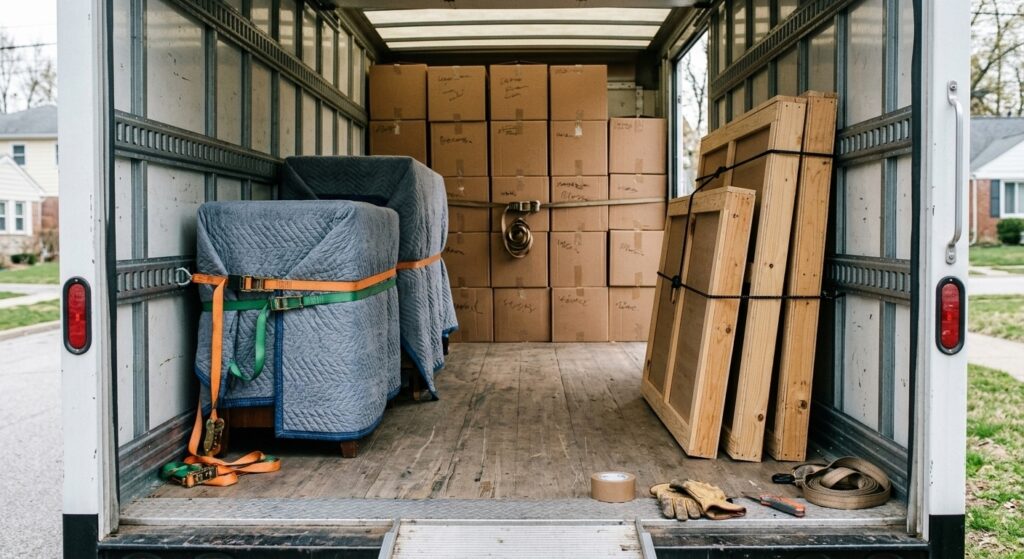
Loading order matters and is not obvious. Heavy and square at the front, soft goods filling the voids, anything fragile last and secured separately. Framed pieces, mirrors and anything with glazing travel upright and packed apart from each other, which I went into properly in the piece on moving art and antiques.
The load then gets restrained. The DVSA’s code of practice on securing loads covers vans and cars as well as lorries, and an insecure load is an offence rather than a matter of preference. Straps and a proper load bar are what stop a wardrobe arriving as firewood.
The parking work that nobody sees
Searching for house movers near me will give you plenty of firms. Fewer of them know which side of your street the controlled hours change on.
Several main roads across this part of West London are TfL red routes rather than borough-controlled streets, and they are a different legal regime entirely. Transport for London grants red route dispensations for stopping on single or double red lines only in exceptional circumstances, such as moving heavy items, and may send a traffic engineer to review the location first. Where one is granted, the fee is £48 per day per vehicle on red lines, or £38 per day per vehicle to sit in a loading or parking bay. TfL will normally expect loading to happen in a nearby bay rather than directly outside the door.
So the real work is finding the legal spot on a side street and planning the carry from there. That decision is made during the survey, not at eight in the morning with a loaded van and a warden approaching.
Where movers prices and quotes come from
The movers cost you are quoted is volume, plus crew hours, plus access difficulty, plus anything specialist. Distance is usually the smallest part of a local move.
Ask for a written, itemised quote rather than a figure over the phone. It should name what is included, what would change the price on the day, and whether packing, dismantling and materials sit inside or outside the number. Comparing movers quotes only works when they cover the same scope, which they frequently do not.
The British Association of Removers publishes a Trading Standards approved code of practice for its member firms, alongside an advance payment guarantee scheme. Membership is not a legal requirement and plenty of good independents sit outside it, though the code is a fair benchmark for what a quote and a contract should contain.
Cheap movers usually get there by carrying less insurance, fewer crew or no survey. One of those three will surface on the day, and it will not be at a convenient moment.

What good house movers will not do?
We will not disconnect a gas appliance, because that needs a Gas Safe registered engineer. We will not plumb in a washing machine at the new address unless that has been agreed in advance as separate work. We will not take a piano down a period staircase without the right equipment and a proper look first.
Being clear about the limits is part of the service. A survey that identifies a job as outside our scope has done something useful, in the same way that planning access for a gallery move means deciding what needs specialist handling before anything is lifted.
House movers earn their fee on the decisions, not the lifting. Volume measured properly, access walked in advance, a parking plan that survives contact with a Tuesday morning, a load that is genuinely secure. We quote fixed and transparent after seeing the job, across Notting Hill, Kensington, Holland Park and the wider West London area, and the goal is a day where nothing surprising happens at all.