

Transport gallery work for Frieze London requires a measured plan for packing, access, loading and delivery. Each painting, sculpture or framed work needs a condition record, suitable protection and a secure position in the removal van. Move-on Up provides insured art transport across West London for galleries, dealers and collectors, with fixed quotes, flexible scheduling and practical preparation for busy fair-week streets.
Frieze London and Frieze Masters return to The Regent’s Park from 14 to 18 October 2026, so galleries should expect tighter loading access, heavier traffic and less room for last-minute changes. The official Frieze visitor information confirms the dates and venue. A successful gallery relocation starts well before the fair opens, especially where work is travelling from a gallery, storage facility or private collection in West London.
Transport gallery work starts with the condition check
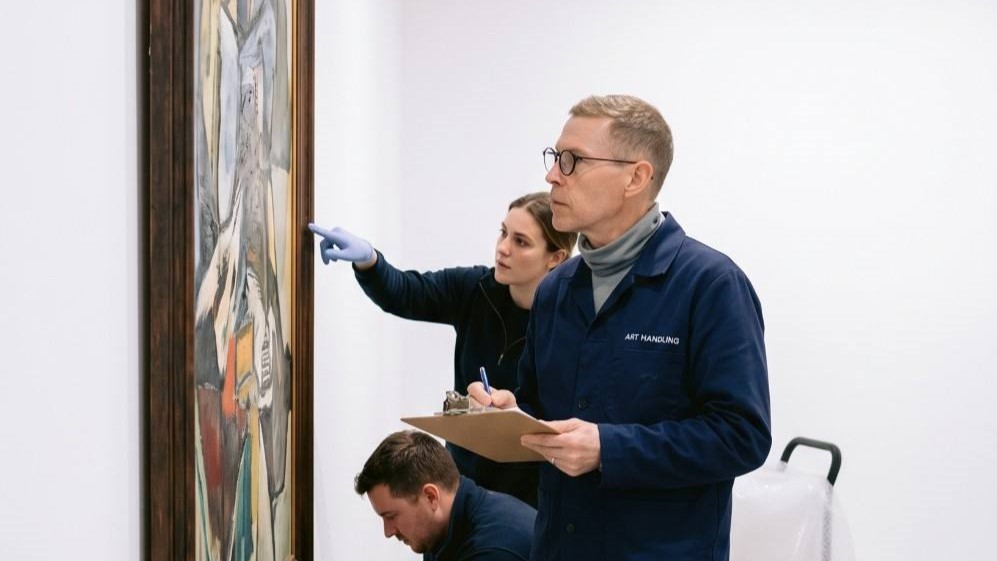
Before transport gallery pieces, record their condition. Photograph the front, reverse, frame edges, glazing and any existing marks. Add dimensions, weight where known, handling instructions and a clear reference number. This gives the gallery, buyer and transport team the same starting point.
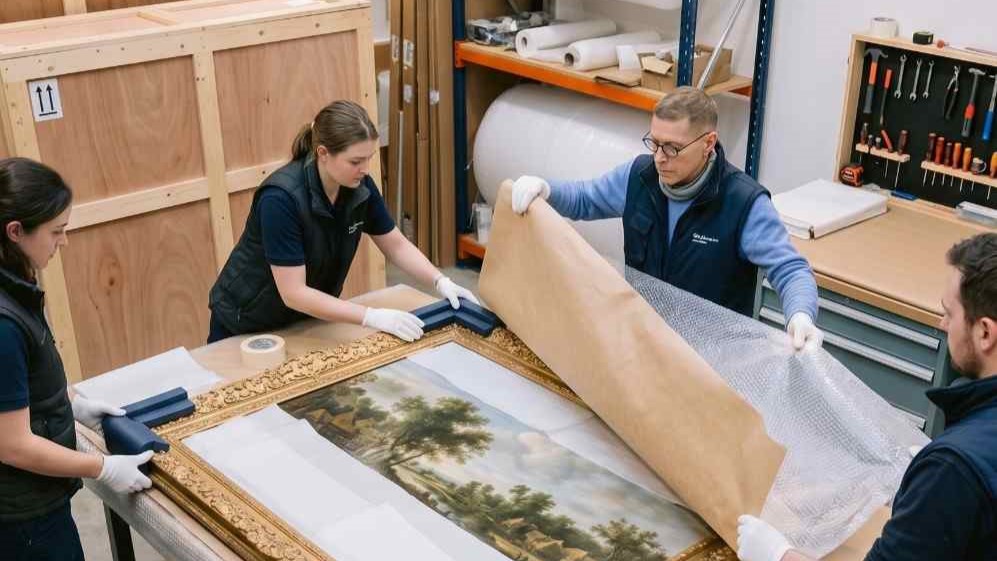
The work itself determines the packing method. A glazed print, an oil painting with a raised surface and a freestanding sculpture each need different protection. We assess the frame, surface, fittings and centre of balance before handling anything. A heavy gilt frame needs support from underneath. A large canvas may need a rigid board or crate, particularly if it must travel through multiple locations.
The American Institute for Conservation advises owners to consider the specific material needs of their collections. That principle applies directly to gallery transport. One blanket approach does not suit every artwork.
Plan access before Frieze week
West London buildings create their own challenges. A white-cube gallery may have straightforward ground-floor access, while a private viewing room in a Kensington conversion may involve a narrow communal stairwell, a small lift or a sharp turn at the landing. The crew needs those details before loading day.
Measure doorways, lifts, corridors and stair turns. Check whether the building has delivery rules or restricted hours. If a work cannot travel safely through the proposed route, it is better to know before the crate is built or the van is booked.
For galleries arranging specialist art transport in Kensington, we discuss access at both ends, the collection sequence and the safe carrying route. This preparation avoids a piece waiting unnecessarily on a pavement or being forced around an awkward corner.
Transport gallery work with a realistic parking plan
Parking can decide whether a carefully organised collection runs to time. Around Notting Hill, Holland Park and Kensington, a removal van may have to contend with resident bays, controlled parking zones and crowded streets. A long carry adds risk, especially for large framed work or heavy sculpture.
The Royal Borough of Kensington and Chelsea says a resident parking-bay suspension normally needs ten working days’ written notice. A pay-by-phone bay suspension usually needs two working days’ notice. Read the council’s parking suspension guidance before relying on a collection slot outside a gallery or residence.
During Frieze London and other art fairs, build extra time into the schedule. Deliveries can be affected by congestion, event traffic and changes at the venue. Early communication between the gallery, venue contact and transport team helps avoid an expensive wait with a loaded van.
Packing, lifting and vehicle loading
Fine art transport is controlled at each handover. We prepare materials before removing work from the wall or display area. Depending on the piece, this can include glassine or acid-free tissue, foam corner protection, padded blankets, rigid boards and a tailored crate. We do not tape directly onto an artwork or frame.
Professional art movers clear the route first. Loose packing materials, rugs and furniture should not be left in a carrying path. The Health and Safety Executive says handlers should plan the lift, keep the load close to the body, avoid twisting and use assistance where necessary. Its manual-handling guidance supports the careful, coordinated approach required for awkward or fragile works.
Inside the van, artwork travels in a planned position. We secure it against movement, keep it separated from heavy furniture and avoid treating it as a last-minute space filler. A framed work may be light enough for two people to lift, but it can still be vulnerable to pressure, vibration and a poorly placed restraint.
For jobs involving wider premises moves, Move-on Up can combine office removals, professional packing and gallery transport under one coordinated plan. That helps keep artwork separate from general equipment, desks and display furniture.
What galleries should confirm before booking
Gallery transport works best when the brief is clear. Give the transport team the collection address, final delivery point, contact names, access times and a list of each work. Include the order in which pieces need to be unloaded, especially if they are headed to a fair stand, private view or temporary storage.
Ask art transport companies what their fixed quote includes. It should account for crew size, packing materials, access, parking and any waiting time that can reasonably be anticipated. Move-on Up provides transparent quotes with no hidden fees, and our goods-in-transit and public-liability insurance form part of a professional service.
An art mover should also be honest about the limits of their role. We can pack, protect, carry and transport a work with care. Restoration, authentication and assessment of unstable surfaces belong with a qualified conservator. If paint is flaking, a frame is loose or an object has a known condition issue, obtain conservation advice before arranging the move.
Our guide to moving art and antiques in Notting Hill explains why a suitable crate and a pre-checked route are often more important than simply adding more padding.
A practical fair-week checklist
For Frieze London, satellite exhibitions and other Art Fairs, gallery transport should be booked with enough time to solve the real constraints. Check the work, check the route and check where the van can load. Then make sure every person involved has the same collection and delivery information.
- Photograph and list every work before packing.
- Confirm dimensions, surface sensitivity and packing requirements.
- Measure access at collection and delivery points.
- Arrange parking or loading permissions where needed.
- Provide venue contacts, time slots and unloading order.
- Keep works secure and separated in the van.
- Confirm insurance arrangements for the value and nature of the collection.
Transport gallery work is a practical job, but it demands attention from the first condition photograph to the final placement. Dougal and the Move-on Up team work throughout West London with flexible evening, weekend and same-day availability where the move can be arranged safely. For Frieze week, earlier planning gives a gallery more control over the details that matter.